Pages

Showing posts with label Brookes Publishing. Show all posts

Thursday, June 22, 2017

Where It's AT Blogiversary: Giveaway #3: Coughdrop License & Brookes Publishing Books

*Update: Congratulations to our randomly selected winner: Laura D.! Be sure to check out each day's giveaways!*


For day 3 it only seemed right to put together, not 1, not 2, but THREE products to giveaway to you, with totals valuing over $300!!! 

Today's giveaway comes courtesy of CoughDrop and Brookes Publishing. Be sure to enter to win a full AAC license by CoughDrop [valued at $200} and TWO hardcopy titles from Brookes Publishing:
 Teaching Communication Skills to Students with Severe Disabilities [valued at $50] and Alternative and Augmentative Communication [valued at $85]. Read below to learn more about each of the products available! 


The first item of today's giveaway is a download of the augmentative communication license by CoughDrop

At CoughDrop they believe that every voice should be heard. Disabilities like autism, cerebral palsy, Down syndrome, Angelman syndrome and Rett syndrome make it harder for individuals to communicate on their own. Many people use Augmentative and Alternative Communication (AAC) tools in order to help make their voices heard.

CoughDrop works to help bring out the voices of those with complex communication needs through powerful open-source technology that actually makes things easier and supports everyone in helping the individual succeed.

The following video provides an overview of the powerful tool created by CoughDrop.


The final two items of today's giveaway are brought to you by 

The mission at Brookes Publlishing is simple: All people—regardless of ability or background—deserve to achieve their goals and lead fulfilling, self-directed lives. Partnering with top experts, the publishing company delivers relevant, high-quality, research-backed content in optimal form.

Brookes Publishing provides the latest printed and e-books, and book series on critical topics spanning from Early Childhood to K-12 to Higher Education to Community Supports.

The first book is included in today's giveaway is...

Kathryn D. Peckham-Hardin

Synopsis: How can educators and therapists support effective communication for students with severe and multiple disabilities? Today's best research and strategies are in the NEW third edition of this trusted textbook and teaching guide. Current and future education professionals will get up-to-date information and practical guidance on the entire process of supporting communication for students of all ages, from assessing their communication skills to involving peers and adults in intervention. An important textbook and professional reference, this comprehensive volume will help educators, paraprofessionals, SLPs, and other school staff skillfully support every student's right to communicate.


The second book included in today's giveaway is...

by David R. Beukelman and Pat Mirenda


Synopsis: As AAC use continues to flourish and new technology revolutionizes the field, tomorrow's service providers need current, authoritative information on AAC for children and adults with communication disorders. That's why David Beukelman and Pat Mirenda have revised and updated the bestselling Augmentative and Alternative Communication—the trusted, widely adopted graduate-level text on communication disorders and AAC. The foundational textbook for SLPs, OTs, PTs, teachers, and other professionals in clinical and educational settings, this fourth edition is a definitive introduction to AAC processes, interventions, and technologies that help people best meet their daily communication needs. Future professionals will prepare for their work in the field with critical new information on

  • advancing literacy skills (new chapter by Janice Light and David McNaughton)
  • conducting effective, culturally appropriate assessment to determine AAC needs
  • choosing AAC interventions appropriate for age and ability
  • selecting AAC vocabulary tailored to individual needs
  • using new consumer technologies as easy, affordable, and non-stigmatizing communication devices
  • understanding types of symbols and how individuals use them
  • promoting social competence
  • supporting language learning and development
  • providing effective support to beginning communicators
  • planning an inclusive education for students with complex communication needs
Readers will get a thorough overview of communication and AAC issues for people with specific developmental disabilities (including cerebral palsy, intellectual disability, and autism) and acquired disabilities (such as aphasia, traumatic brain injury, and degenerative cognitive and linguistic disorders). And with helpful photos, figures, and photocopiable forms, readers will be ready to collect and use important information on assessment, individual communication needs, classroom supports, and more.

An essential core text for tomorrow's professionals—and a key reference for inservice practitioners—this new fourth edition expertly prepares readers to support the communicative competence of children and adults with a wide range of complex needs.

Tuesday, April 25, 2017

28 Ways Peers Can Support Students with Disabilities

Peer supports are one of the most effective ways to help students with disabilities reach their potential and ensure that their academic and social needs are met. Whether you’re implementing a formal peer buddy program or more informal student-to-student partnerships, peer supports don’t have to require a huge time investment—but before you begin, the young people participating will need some preparation and guidance. 


Today's post, from Brookes Publishing: The Inclusion Lab blog, provides 10 tips on helping students to provide the most effective, appropriate supports to their peers with disabilities.


Read the full article 10 Practical Principles for Peer Support: Getting Students Ready to Help


Article Source: Brookes Publishing

Wednesday, April 19, 2017

5 Types of Adaptations for your Inclusive Classroom


The Brookes Inclusion Lab is an interactive blog which provides tools and resources to promote and enhance UDL and inclusiveness within the classroom learning environments. Today’s post, 5 Types of Adaptations for your Inclusive Classroom, brings you five approaches for adapting instruction in your inclusive classroom, so students with and without disabilities can participate and learn academic content. Adapted from Rachel Janney & Martha Snell’s practical guide to Modifying Schoolwork, these strategies can be used in any combination to best meet the needs of your individual learners. After testing these strategies out, please share below in the comments which adaptations have worked best in your classroom!


 Grab a peek at the five adaptations below, and
*Alter the instructional arrangement

*Alter the physical or social environment

*Alter your methods and materials

*Alter the process or task

*Alter the level of personal assistance


Thursday, October 27, 2016

Fair is Not Always Equal eBook

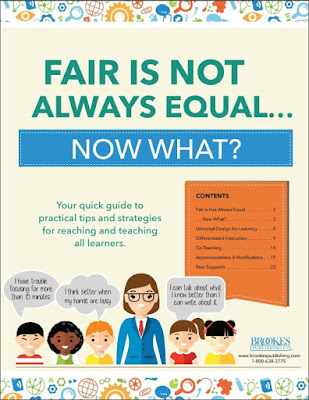
Several weeks ago I shared the Fair Is Not Always Equal infographic created by the Inclusion Lab from Brookes Publishing. The post (as well as the 25 subsequent resources available in the F.I.N.A.E. series) drew tremendous popularity on social media, so it seemed fitting to share the latest eBook that was developed. 

http://www.brookespublishing.com/campaigns/fair-not-equal/?utm_source=blog&utm_medium=post&utm_campaign=fair-is-not-always-equalThe eBook includes ready-to-use tips on hot topics like planning UDL lessons, strengthening co-teaching partnerships, teaching to multiple intelligences, maximizing student engagement, and using accommodations and modifications from some of today’s top experts on UDL, co-teaching, and inclusive education, including Loui Lord Nelson, Nicole Eredics, Elizabeth Stein, and Kathleen McClaskey. Additionally, the eBook shares the success stories of educators who’ve been there, done that, and made inclusion and differentiation work in their own classrooms.

The ultimate goal of the resource is to provide helpful hints, strategies and visual infographic at your fingertips for integration into your classrooms.

Click the link or image above to download the free, full-color eBook that excerpts the best posts from the Fair Is Not Always Equal…Now What? series in one convenient place. Keep it as a valuable inclusion resource, and please share it around with anyone interested in the nuts and bolts of meeting every learner’s needs.

Source: The Inclusion Lab from Brookes Publishing

Tuesday, September 27, 2016

What Is UDL and How Can You Make It Work in Your Classroom?


You’ve probably been differentiating instruction for your students in one way or another since you started teaching, so you may be wondering, “What’s all the buzz about universal design for learning (UDL)?” Sure, planning all your lessons to cater to every student’s individual learning style is ideal, but realistically, how can you make UDL work in a classroom of 30 or more students? 


Here are six steps, adapted from Your UDL Lesson Planner by Patti Kelly Ralabate, to make UDL lesson planning work in your classroom and give all students an equal opportunity to learn.


STEP 1: Ready. Set. Goal!
First, ask yourself, “What’s the goal of this lesson?” (Hint: Many times Common Core or state standards help you figure it out.) Even though the standards may be a starting point, the learning goals should focus on your students—specifically their knowledge, skills and perceptions. Try to make goals SMART: specific, measurable, attainable, results-oriented and time bound. It sounds like a lot of work, but taking time up front to make sure goals are solid, makes everything else easier.


STEP 2: Think through individual differences.
Before you dive into teaching your lesson, take a few minutes to think about variability in your students—any individual differences in their current skills, learning gaps and needs. Do you have a student who gets easily distracted or may feel frustrated for some reason? Think about what types of scaffolding (e.g., pre-teaching vocabulary) you can use to set up your students for success.


STEP 3: Decide how you’ll check that students are “getting it.”
Think about how you’ll check your students’ understanding throughout the lesson to make sure they’re meeting the goals you set. Besides helping you know if your students are “getting it,” informal checks can also help you see whether you’re teaching too fast or slow or if the information is clear. If you have students who are on an IEP or 504 plan, find out if they have any assessment accommodations you need to provide.


STEP 4: Pick and choose materials and methods wisely.
To make learning motivating and memorable, ask yourself questions like, “Are these math manipulatives distracting or will they actually help my students learn?” This is also a good time to think back to your students’ individual differences and plan accommodations or modifications, like using different colored markers on the whiteboard or allowing a student more time to finish an activity.


STEP 5: It’s time to teach!
Now it’s time to pull it all together and deliver your awesome UDL lesson. Throughout your teaching, try to use a flexible approach to check your students’ understanding and make sure they meet the learning goals you set.


STEP 6: Hold a mirror up to your lesson.
After your lesson is over, take time to think about how it turned out. What worked well? What will you do differently next time? Did all your students achieve the learning goals you set? What’s next?
 

How does UDL lesson planning look in real classrooms? Visit the Brookes Inclusion Lab to see how three teachers with very different needs use these six steps in their lesson planning.


Click on the link to access the original article by Jen Lillis on the We Are Teachers website (sponsored by Brookes Publishing)

Wednesday, September 14, 2016

How to be an A-Plus IEP Leader


With many teachers already back to school or with the new school year just on the horizon, you’ve probably been thinking about your current/incoming class and all the ways to support your diverse learners.

So, let’s talk IEPs. Specifically, what you can do as an educator to lead and support a smooth IEP process, from start to finish.

Below you can find a handy booklet of quick tips for you—it’s adapted from a recently published book, The Educator’s Handbook for Inclusive School Practices by Julie Causton and Chelsea Tracy-Bronson. It outlines what to do:
  • A month before an IEP meeting
  • The day of the meeting
  • After the meeting
You’ll also get some helpful tips to keep in mind during the whole IEP process to ensure the best results for everyone involved.

Download the booklet here, and please share with your friends who are passionate about inclusive education.

inclusive educators lead the IEP process