Digital Does Not Equal Accessible is an article written by Hillary Goldwaith-Fowles, PhD, ATP, which focuses on an important area of discussion that arises in the field of assistive technology. It is often a misconception that because materials are presented digitally this would also imply that they are accessible for those who need materials to be presented in such a way. With the help of her Twitter PLN, Dr. Fowles helps to break down how digital does not always equate to accessible, and how we as professionals, parents and even students can help to ensure that materials are accessible to those who require them to be. Read the article featured below or click here to access Hillary's website to read this article and others she has shared.

Interested in learning more? Be sure to grab a copy of Hillary's book One Size Does Not Fit All: Equity, Access, PD and UDL.
We’ve recently refreshed the copiers in our district. You’d think this wasn’t a big deal, however, the ability to scan in color is pretty exciting (I know, it doesn’t take much to bring joy to my world)! This opens up a whole new level of possibility for teachers who, with the best of intentions, want to ensure that students have access to content on a tablet or laptop.
This is a great idea. Paperless classrooms are now a “thing”, and that’s great for the trees and the environment! Simply scanning documents into a copier and posting them in Google Classroom DOES make them digital. It DOES lend itself to a paperless classroom. However, what it does NOT do is make that media ACCESSIBLE.
What does accessible mean? When we are talking about content that is on a computer phone, or tablet, we mean that ANY user can use tools to access the content (i.e. screen reader, text to speech, magnification software, etc). The content literally comes to life for a user with (or without) disabilities.
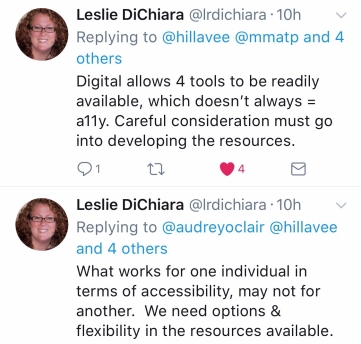
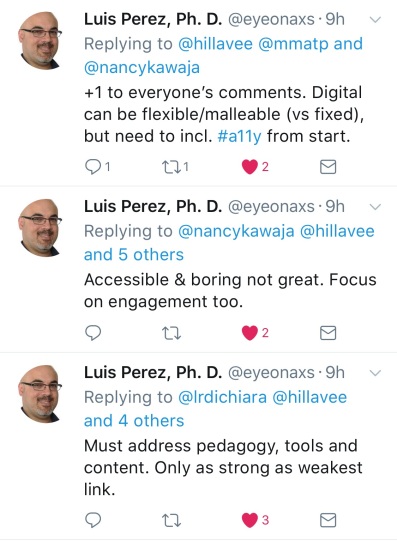
I posed this question a while ago on “the Twitter”, as I know I’m not the first person to talk about this concept, or face this dilemma in their setting. In reaching out to my PLN (Professional Learning Network, I received some wonderful responses! Here’s what they had to say when I posted the graphic “Digital does not Equal Accessible” and asked for their thoughts.
In other words- ALL means ALL.
In other words, intentional use, with end user (i.e. students) as focus.
In other words, don’t be afraid to explore and allow students to explore as well!
In other words- Dear Developers, please listen to us as you continue to develop tools to support ALL learners.
There are no other words here- this about sums up this whole blog post!
In other words, forethought, not afterthought.
In other words, leverage UDL.
I also took the time to email John Brandt from MaineCite and Cynthia Curry from CAST and the National Center on Accessible Educational Materials (AEM Center) on the subject, as their primary roles in their work center around accessibility.
John graciously shared some resources, which help in building understanding around accessibility as a forethought, not an afterthought:
Cynthia Curry, in the most eloquent of ways, summed up how to think about accessibility rather nicely:
“Materials can be born print and require retrofitting
Materials can be born digital but difficult or impossible to retrofit
Materials can be born accessible and thereby readily usable”
I hope this post and resources are helpful to you in developing deeper understanding of accessibility. Many thanks to John Brandt, Cynthia Curry, Leslie DiChiara, Nancy Kawaja, Mike Marotta, Cheryl Oakes, Audrey O’Clair, and Luis Perez for their time, expertise, and invaluable contributions.
” Do the best you can until you know better. Then when you know better, do better”
– Maya Angelou*.
*Cynthia Curry used this quote in a presentation at ACTEM in October. I love it.
Permission to share this article directly on the Where It's AT blog was granted by the author of the article.